When Brewster Perkins decides a nonprofit is worthy of his support, it comes with an unusually informed perspective.
For more than four decades, Perkins built a career helping Connecticut nonprofits manage risk, strengthen their governance and fulfill their missions. He also spent 14 years on the board of the Hartford Foundation for Public Giving (now Greater Hartford Gives) and 15 years on the board of University of Saint Joseph, giving him a front-row view of philanthropy and the nonprofit community across Connecticut and Greater Hartford.
Among the many organizations he has encountered, Community Partners in Action has held a special place for more than 40 years.
Perkins’ relationship with CPA began in 1985, when then-Executive Director Gordon Bates asked for his help. At the time, Perkins was building a successful insurance business with an unusual specialty: nonprofits.
Many insurers viewed nonprofit organizations, particularly those working with people involved in the criminal justice system, as difficult risks they didn’t want to insure.
“Alternative incarceration, well, that is the scariest term you possibly could present to an insurance company,” he recalled.
Perkins believed much of that perception resulted from a lack of understanding. His response was to educate the industry while helping nonprofits better understand risk, governance and the fiduciary responsibilities of their boards.
“I love working with nonprofits,” he said. “I love the education, and I love the missions, whatever they were.”
That commitment reflected a philosophy that guided much of his professional life. A compelling mission was essential, but nonprofits also needed strong leadership, responsible boards, sound financial management and strategic discipline.
“I actually call nonprofits, social capitalism,” Perkins said. “Because if they don’t run their business correctly and aren’t creative with a passion, they die, like any business.”
Perkins found nonprofit leaders and boards were often “starving for education.” He spent countless hours helping directors better understand their roles and responsibilities and saw firsthand the connection between leadership and governance.
“If you had strong executive leadership, you attracted a very strong board,” he said.
CPA impressed him on all counts.
Good executive leadership attracts strongly committed board members and vice versa, as a symbiotic relationship is required to truly execute a nonprofit’s mission. Both need each other and too much of one can also suffocate the other. Board responsibility is a commitment of passion, creativity, and wisdom. Serving on a Board takes time, listening, asking questions, and most of all not getting involved with the day-to-day management.
Perkins helped insurers better understand CPA’s work and advocated for the organization to secure critical coverage. At the same time, he came to recognize something distinctive about CPA itself: its willingness to work with people others might overlook, coupled with strong management, innovation and a commitment to results.
Over the years, the professional relationship became personal. Perkins developed great respect and fondness for Bates, his successor Maureen Price-Boreland and current Executive Director Beth Hines.
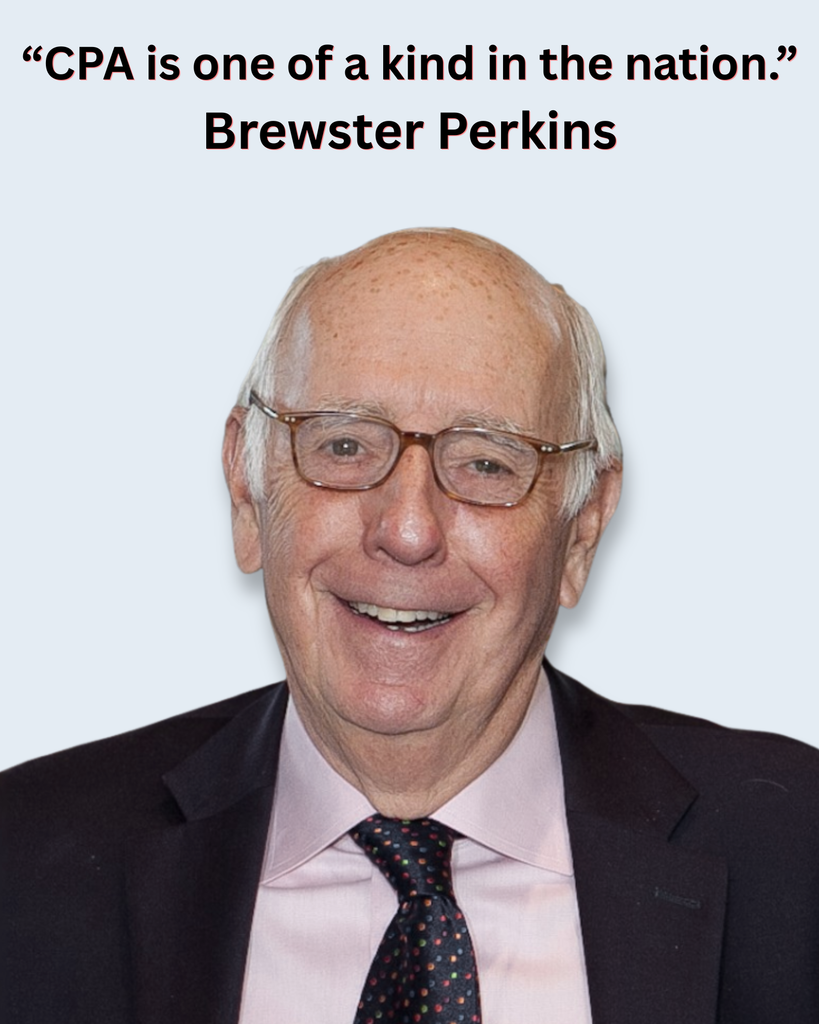
Today, he considers CPA exceptionally well managed, both financially and strategically, while carrying out a mission he believes is essential. From his broad experience working with nonprofits, Perkins considers CPA “one of the leading organizations of its kind in the nation.”
His commitment to service, however, began long before his career.
A native of Plainfield, New Jersey, and a graduate of Trinity College, Perkins came of age as President John F. Kennedy challenged a new generation of Americans to embrace public service.
“Ask not what your country can do for you,” Kennedy famously told Americans in his 1961 inaugural address, “ask what you can do for your country.”
Perkins was part of that generation, although the instinct to serve had been instilled even earlier.
“I grew up in a family invested in community service,” he recalled. “I just thought that’s what everybody did.”
Another defining relationship was beginning as well. Brewster met his future wife, Judith, in 1960. She would share the remarkable journey that followed, through his Peace Corps and military service, his return to Hartford and the decades in which they raised their three children and built their lives together.
Perkins joined the Peace Corps and spent two years in India working in agriculture, followed by another year recruiting volunteers in the United States. Created under Kennedy in 1961, the Peace Corps offered his generation a way to put that call to service into action.
He arrived in India with little agricultural experience. He and other volunteers taught themselves about poultry farming and worked with local communities to improve productivity. But what stayed with him most was not what he brought to India.
“I didn’t do anything to India,” he said, “but India did everything to me.”
Kennedy’s assassination in November 1963 also left an indelible impression.
“It changed our life,” Perkins recalled of his generation. “Absolutely changed our life.”
Following the Peace Corps, Perkins served in the U.S. Army, including time in Panama, where Judith joined him while pursuing her doctorate in Classics and Humanities. They later returned to Washington, D.C., before Brewster left the Army and began his next chapter in Hartford.
In 1971, he entered the insurance business. He later earned an MBA from the University of Connecticut under the G.I. Bill and started his own agency in 1981.
His professional career and commitment to service increasingly converged.
Perkins developed insurance products designed for nonprofits and eventually helped create an insurance captive that included approximately 120 organizations, providing coverage better suited to their needs at a more competitive price. His work gave him an unusually broad view of what makes mission-driven organizations succeed and what can cause them to fail.
It also helps explain his enduring connection to CPA.
Education is one of the threads Perkins sees connecting his own life with the organization’s mission. Just as he spent his career educating insurers and nonprofit boards, he sees CPA educating policymakers and the public about criminal justice and reentry while giving young people and adults the knowledge, skills and support they need to move forward.
There is also a personal dimension to his belief in CPA’s work.
Perkins understands that circumstances can play a significant role in the opportunities people receive and in how they are treated when they make mistakes. Some are afforded understanding and the benefit of the doubt, while others, often facing far greater challenges, encounter consequences that can alter the course of their lives.
That perspective has reinforced his belief that people deserve equitable opportunities and a genuine chance to move forward.
Today, that belief extends to his philanthropy and donating to CPA, an organization whose leadership, financial stewardship and impact he has come to know firsthand over four decades. He also helped educate CPA about the benefits of accepting gifts of appreciated stock and other planned giving options, which the organization now offers to donors.
For Perkins, philanthropy is about more than donating. His career has taught him to examine how a nonprofit is governed, how it manages its resources, the quality of its leadership and whether its mission produces meaningful results.
By those measures, CPA continues to earn his confidence and support.
Brewster and Judith raised three children, and that commitment to service has carried into another generation. Their son, Austin, now oversees the book of nonprofit clients they built together and is a partner with SmithBrothers, and continues to serve nonprofit organizations.
For someone who has spent much of his life educating, advising and strengthening mission-driven organizations, Perkins’ support of CPA represents something more than philanthropy.
It is a vote of confidence from someone who has spent more than four decades knowing what to look for. And he continues to choose Community Partners in Action.