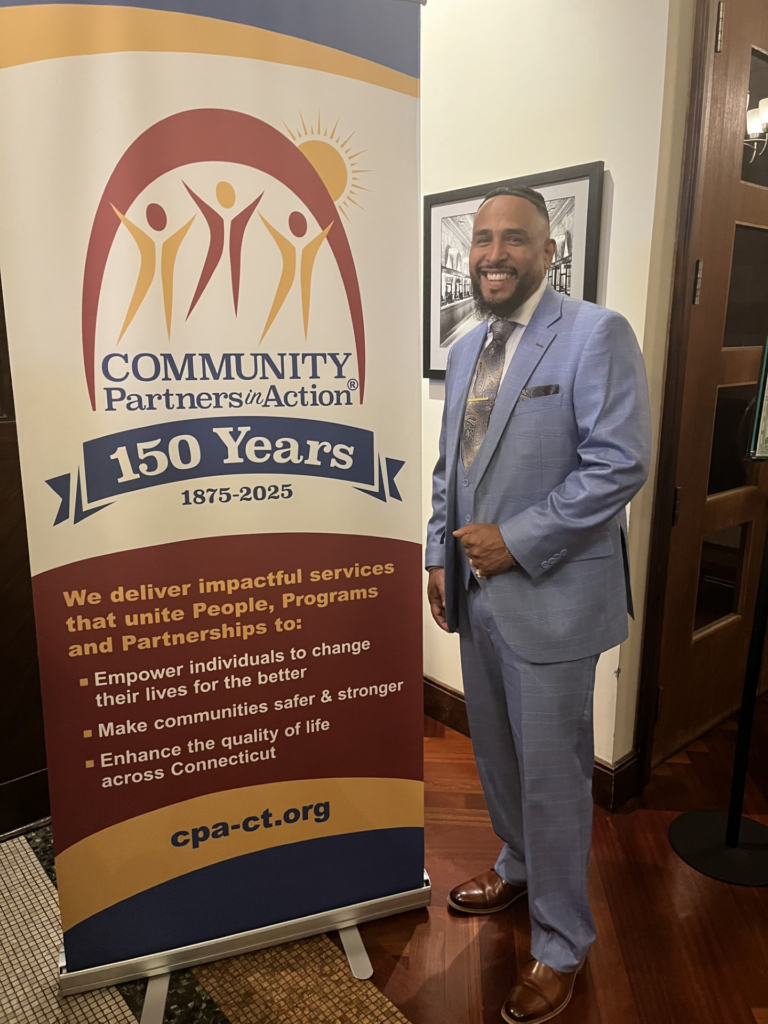
On a winter afternoon at Community Partners in Action’s Hartford Reentry Welcome Center (HRWC), Benito Lugo Baez sits across from a participant preparing for a job interview.
Benito listens carefully. He asks questions. He challenges gently. He encourages firmly. He recognizes the fear behind the silence.
“I was once in your shoes,” he always tells participants, many of whom arrive discouraged after weeks or months of rejection.
“You’ve got to transform ‘no’ into ‘not yet,’” Benito says. “Sometimes you’re not being denied.
Sometimes you’re still preparing. You’re building skills. You’re working through things. And that work matters.”
Today, Benito serves as a Career Navigator at CPA’s HRWC, helping people secure employment and rebuild stability after incarceration. His understanding of reentry is not theoretical. It is lived.
He grew up just around the corner from where he now works.
“I grew up in Bellevue Square,” Benito said. “Right here in the North End of Hartford.”
Born in Fajardo, Puerto Rico, he moved to Connecticut at five years old when his mother fled an abusive relationship. She raised four children under significant financial strain.
“My mother was very strong,” Benito shared. “She did everything she could.”
As a teenager searching for belonging, Benito gravitated toward neighborhood peers who offered protection and identity. What began as defending friends evolved into gang involvement.
At 19, Benito took a life and was sentenced to 40 years in prison.
He served 28 years.
The early years inside were marked by anger, survival instincts, and emotional numbness. Visits with his two young children were conducted through glass.
“One time my kids put their hands on the glass and prayed for me,” Benito recalled quietly. “I had to face who I was.”
Benito shared that prison demands allegiance. The identity that once offered protection on the outside followed him inside. Walking away from that mindset was not automatic, and it was not easy.
“It’s comfortable to stay in what you know,” he said. “Even if what you know is destructive.”
While serving his sentence, Benito began asking himself difficult questions. If he claimed to love his family, did his actions reflect that love?
In 1998, Benito made a conscious decision to change course. He earned his GED and immersed himself in programs focused on growth. Instead of reinforcing prison culture, he began facilitating groups with the Alternatives to Violence Project, mentoring others, and investing in self-reflection.
“I had to decide who I wanted to be,” Benito said. “I couldn’t blame anybody anymore.”
Over time, service became central to Benito’s identity. He facilitated workshops for more than two decades. He became active in Bible study and volunteered in hospice, sitting beside men in their final days. He supported peers through grief when family members died outside prison walls.
“I always found myself helping,” Benito said. “Sometimes the process of getting healed is by helping someone else.”
After multiple denied petitions over the years, Benito applied for commutation. During his hearing, the widow of the man whose life he had taken spoke.
“She said I deserved a second chance,” Benito said. “After 28 years, hearing those words felt like I could finally breathe.” He speaks openly about the emotions and many tears that followed. They still flow today when he recalls that hearing and all that has occurred since.
Benito returned home in March 2022 and continued building the life he had worked toward for decades. When he married, the ceremony was officiated by Apostle William J. McKissick, Jr. who serves as a chaplain at MacDougall-Walker Correctional Institution, where Benito had once worked as his clerk. Over time, Apostle McKissick became Benito’s pastor and mentor, witnessing firsthand the transformation that began behind prison walls.
Today, Benito is an active presence in the lives of his children and grandchildren. He speaks about them with gratitude and humility, aware that the everyday moments he now experiences were once uncertain.
“I don’t take any of it for granted,” he said. “Being present. Showing up. Just being there.”
Benito shared that reentry brought its own challenges and that employment gaps, stigma, and psychological adjustment to freedom can overwhelm even the most determined individual. Yet, he secured work quickly, taking a warehouse job while saving money and rebuilding stability.
“Taking the bus felt amazing,” Benito said. “If it rained, I would get off a few stops before my own just to walk in it. That rain felt good to me.” Small freedoms are not small when they have been absent for decades.
Today, he channels those experiences into his work at CPA’s Hartford Reentry Welcome Center. The center serves 29 cities and towns across Greater Hartford, providing job readiness support, case management, and connections to housing and community services.
CPA also operates the Greater Waterbury Reentry Welcome Center. Each year, hundreds of people return home from incarceration in Hartford and Waterbury. Without guidance, many struggle to secure stable employment, reconnect with family, and navigate the stigma attached to a criminal record.
Benito understands that stigma firsthand.
“You have to know your worth,” he tells participants. “A job might not be your ideal job. It can be your steppingstone.”
During the initial intake and subsequent meetings, Benito talks to participants about adopting the right mindset and taking responsibility. “We talk about not taking this opportunity for granted.”
In nearly two years at CPA, Benito has worked with more than 100 participants. Some remain connected long after their formal case is closed.
“At CPA, once you’re with us, you’re always with us,” Benito said. “We don’t shut the door.”
He has helped individuals who searched for work for a year before landing their first job. He has worked with people convicted of serious offenses who struggle to find housing and employment because of their records.
“We’re not here to judge,” Benito shared. “We’re here to help people heal. If someone doesn’t heal, society is at risk.”
That philosophy reflects CPA’s broader mission. Founded 150 years ago, the organization has long focused on rehabilitation, dignity, and second chances. The Reentry Welcome Centers in Greater Hartford and Greater Waterbury are designed not only to reduce recidivism but to strengthen entire communities.
“If you help one person,” Benito said, “you don’t just help that person. You help their family. Their children. Their community.”
He understands redemption not as forgetting the past, but as actively repairing it.
“I was part of the problem,” Benito said. “Part of redemption is not forgetting and choosing to do something different.”
For those who have never experienced incarceration, Benito’s story offers a window into a reality often misunderstood. Prison is not only punishment. It is separation, grief, lost milestones, and years that cannot be returned.
Reentry is not simply walking out a prison gate. It is rebuilding self, confidence, employment history, and trust. Every day at the Hartford Reentry Welcome Center, Benito sits across from someone at the beginning of that journey.
“I tell them, you don’t know how close you are to your sunrise,” he said. “The darkest time is right before the light.”
Benito knows because he has lived it. And now, he helps others rise.